Kitchens above lakes and coasts · Sounding 01
Sounding 01 · Structures

Pontoons, Hulls and Tethers

Entry 01 · First reading

What holds the dining room up

Every floating restaurant begins as an argument with Archimedes. A platform sinks until it has displaced water equal to its own weight, then stops. The designer's task is to decide how deep that point lies, how the weight is spread across the deck, and what happens when the weight changes — when eighty guests arrive at seven, when the walk-in cold room is restocked at noon, when the lake rises half a metre after the spring melt.

Three families of structure answer that argument differently. Pontoons spread load across many small floats. Barges and hulls concentrate it in a single watertight body. Pile-moored decks avoid floating altogether and stand on columns driven into the bed. Each produces a different feeling underfoot, and each places different demands on the kitchen.
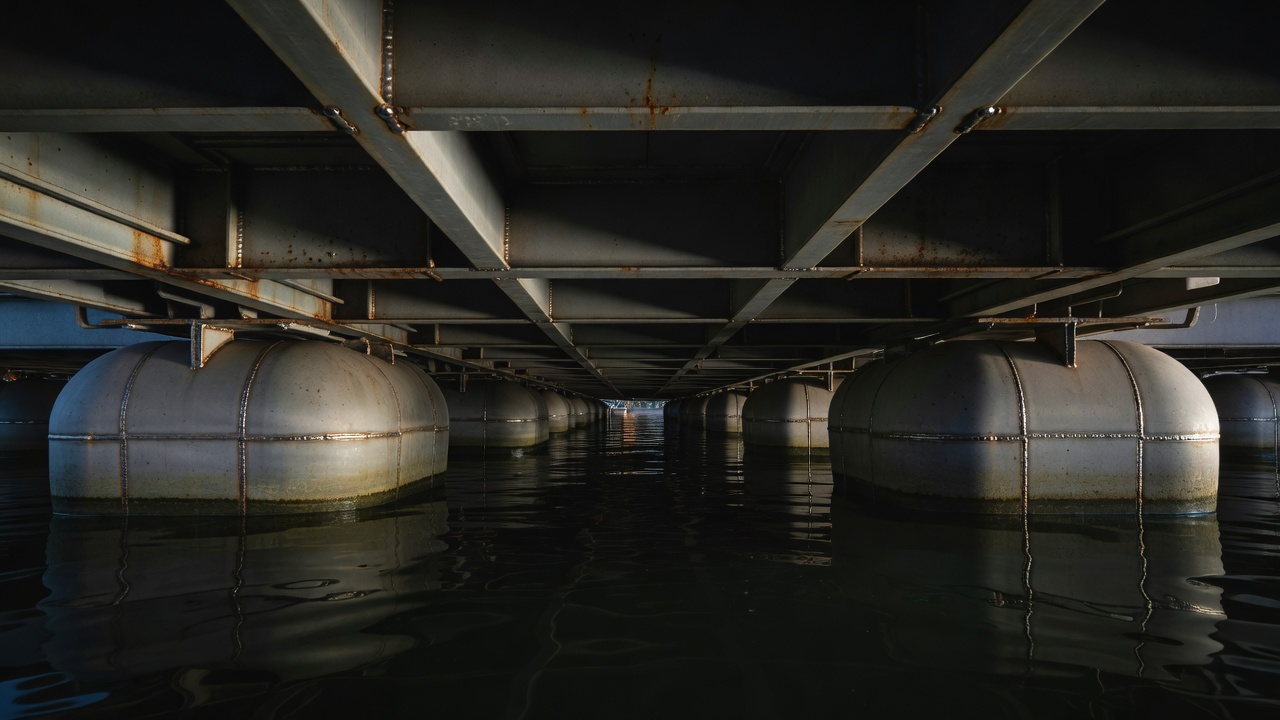
Float chambers, welded and coated, seen from a service boat.
Entry 02 · Comparison table

Three ways to sit on water

TypeTypical buildMotion feltBest waterKitchen note
PontoonModular concrete or steel floats under a timber or steel deckLow on sheltered lakes; slow lift from wakesLakes, marinas, river basinsHeavy equipment placed over float centres
Barge / hullSingle steel hull, often a converted cargo barge or purpose-built vesselModerate; roll depends on beam and ballastHarbours, rivers, sheltered baysGalley usually below or mid-deck, near centreline
Pile-moored deckTimber, steel or concrete piles driven into the bed; deck fixed above high waterNone from waves; vibration onlyShallow lagoons, tidal coastsBehaves like land, but salt air and access limit deliveries

A fourth hybrid — a floating deck guided by vertical piles — combines the first and third: it rises and falls with the water but cannot drift sideways.

Entry 03 · Lines and chains

Tethers that allow, and forbid

A floating kitchen must be free in one direction and fixed in the others. On reservoirs and Alpine lakes the water level can move a metre or more across a year; a restaurant chained rigidly to the bed would either hang from its moorings or pull itself under. The usual answers are guide piles with sliding collars, which allow vertical travel only, or catenary chains whose own weight lets them lift and settle. Newer installations use elastic mooring lines that stretch under load and recover, damping the jerk that a steel chain transmits to the dining room.

Coastal sites add tide. A platform on a tidal estuary may rise four metres twice a day, which turns the gangway into a moving ramp and drags utility hoses through their full length. Designers allow slack, add flexible couplings and specify hinged bridges whose angle stays within accessible limits at the lowest tide.

Entry 04 · Stability

Freeboard, ballast and the quiet deck

Two numbers decide how a platform feels. Freeboard is the height of the deck above the waterline; too little and spray reaches the tables, too much and the structure catches wind like a sail. Metacentric height describes how strongly the platform rights itself after tilting. A large value means a stiff, quick snap back; a small value means a slow, lazy roll that some guests find more unsettling. Restaurant designers usually aim for a wide, shallow platform with moderate stiffness, then trim it with water or concrete ballast so the deck sits level when the kitchen is fully loaded.

Classification societies such as Bureau Veritas, DNV and Lloyd's Register publish rules for floating structures and inspect hulls, welds and buoyancy compartments. Many lake pontoons are instead regulated by local navigation authorities and building codes, but the better operators commission marine surveys anyway.

Entry 05 · Precedents

Landmarks on the water

Bregenz, Lake Constance

The festival's lake stage is not a restaurant, but its pile and float engineering shows how heavy structures sit calmly offshore for whole seasons.

Rotterdam Floating Pavilion

Three linked domes on a floating base in the Rijnhaven, built as a demonstration of climate-adaptive architecture.

Jumbo, Aberdeen Harbour

Hong Kong's floating restaurant closed in 2020 and capsized under tow in 2022 — a lesson that floating buildings need maintenance and a plan for leaving.

Entry 06 · The umbilical

Power, water and what leaves the deck

Out of sight, every floating restaurant hangs on an umbilical: shore power through flexible armoured cable, potable water through food-grade hose, and a return line carrying greywater and sewage to a pumping station on land. Discharge to the lake is forbidden almost everywhere a luxury venue operates, so holding tanks and alarms are part of the design. Fuel, where any is used, is stored in bunded tanks away from the galley. When you step across the gangway, those lines are usually running beneath your feet.

The next sounding follows them into the kitchen itself.

Read the Log